
Middle Back Pain While Sleeping: 6 Effective Ways to Wake Up Pain-Free
You fall asleep fine, but wake up with a dull ache between your shoulder blades or a tight band of tension across the middle of your back. If middle back pain while sleeping is a regular occurrence, you are not alone. It is one of the most common complaints among desk workers, parents, and anyone who spends long hours in a fixed position during the day. The good news is that most cases have a clear cause and a practical fix. This guide walks you through why it happens and exactly what to do about it.
What Causes Middle Back Pain While Sleeping?
The middle back, or thoracic spine, is naturally more rigid than the lower back due to its connection to the rib cage. While this stability protects vital organs, it also means the area is less forgiving when placed under sustained pressure or held in a poor position through the night.
Common causes include:
- Poor sleep posture that forces the thoracic spine out of its neutral alignment
- An unsupportive mattress that allows the mid-section to sink and arch unnaturally
- Muscle tension carried over from poor daytime posture, especially from prolonged sitting
- Tight muscles around the diaphragm, which attaches to the thoracic vertebrae and can cause referred pain in the mid-back region when under stress
- Staying in one position for too long, which reduces circulation and allows inflammation to build in already-sensitive tissue
According to the NHS, back pain is one of the most common reasons people see a GP, with most cases linked to lifestyle factors rather than structural damage. That is reassuring because it means the majority of middle back pain while sleeping can be addressed without medical intervention.
1. Adjust Your Sleep Position to Protect Your Middle Back
Your sleep position is the single biggest controllable factor when it comes to middle back pain while sleeping. The two best positions are back sleeping and side sleeping, each with a specific technique to keep the thoracic spine aligned.
If you sleep on your back, place a pillow under your knees. This flattens the lumbar curve slightly and takes pressure off the entire spine, including the mid-back. If you sleep on your side, place a firm pillow between your knees to prevent your top hip from rotating forward, which can torque the thoracic spine. A full-length body pillow works well for side sleepers as it also supports the midsection.
Stomach sleeping is the position most likely to cause middle back pain while sleeping. When you lie face down, the mid-section sinks and forces the thoracic spine into extension. If you cannot break the habit, placing a flat pillow under your pelvis reduces the pressure significantly.
2. Stretch Before Bed to Release Thoracic Tension
Spending 5 to 10 minutes on targeted stretches before bed can make a noticeable difference to how your middle back feels when you wake up. The goal is to gently mobilise the thoracic spine and release the muscle tension that builds up during the day.
Useful pre-sleep stretches include:
- Child’s pose, held for 60 seconds
- Seated thoracic rotation, turning gently to each side 10 times
- Cat-cow movements on the floor, 8 to 10 slow repetitions
- A gentle supported backbend over a rolled towel placed under the mid-back
Consistency matters more than intensity here. A gentle nightly routine conditions the muscles around the thoracic vertebrae and reduces the stiffness you carry into sleep.
3. Use a Back Stretcher to Decompress the Spine Before Sleep
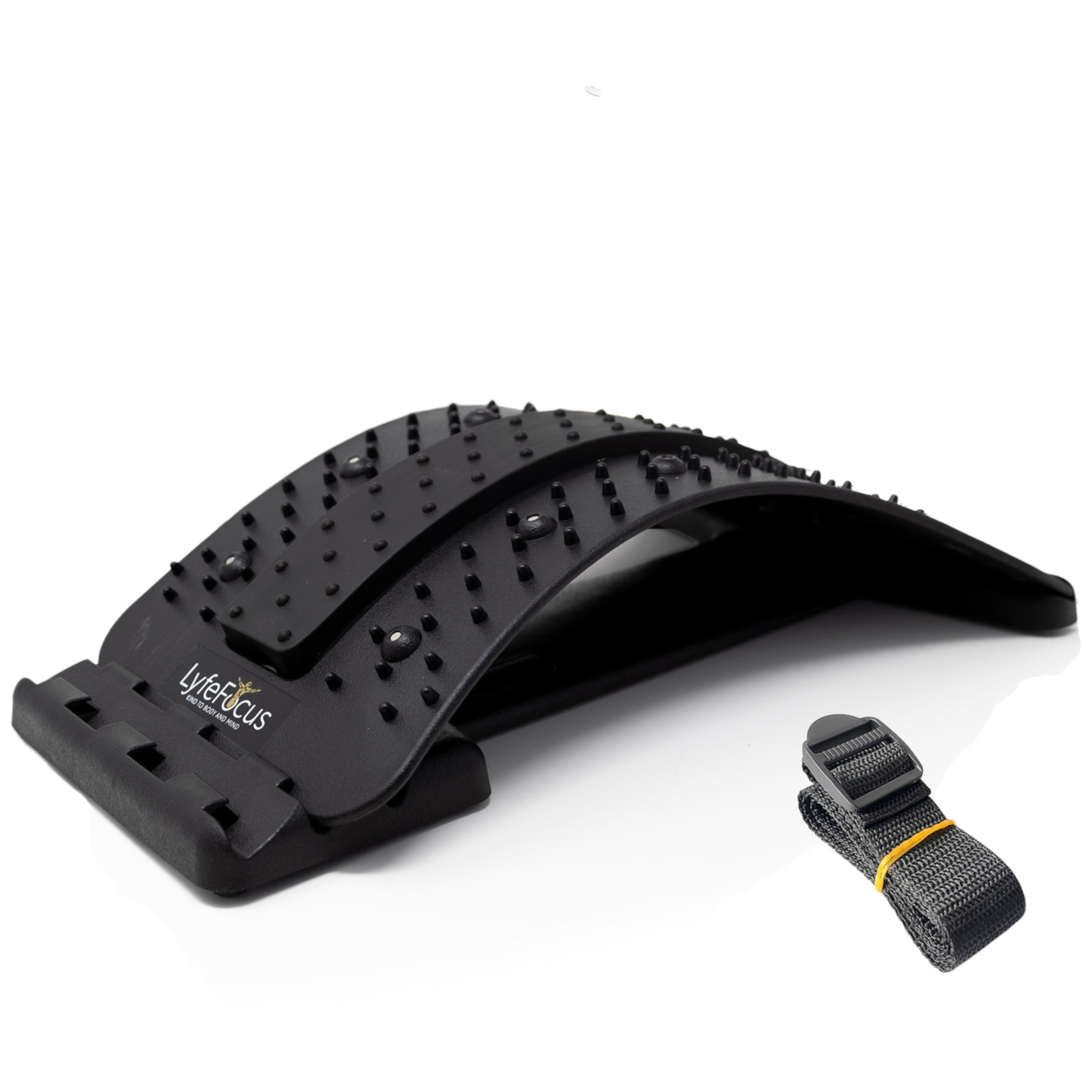
One of the most underused tools for middle back pain while sleeping is a dedicated back stretcher. Spending 5 to 10 minutes on a back stretcher before bed gently opens the thoracic joints, lengthens the muscles alongside the spine, and promotes the kind of deep relaxation that makes sleep more comfortable.
The LyfeFocus Back Stretcher S1 is designed to target the mid and lower back with a curved surface that encourages the thoracic spine into its natural extension. Unlike lying on a rolled towel, the contoured design distributes pressure evenly and allows for a gradual, controlled stretch rather than an abrupt one. Even five minutes before sleep can reduce the tension that would otherwise build overnight into a painful morning ache.
4. Evaluate Your Mattress and Pillow
A mattress that is too soft allows the heavier parts of the body to sink, creating a misaligned spine throughout the night. A mattress that is too firm creates pressure points at the shoulders and hips, forcing the mid-back into a compensatory curve. A medium-firm mattress is generally recommended for people with thoracic pain.
Pillows play an equally important role. If your pillow is too high or too flat, your neck tilts at an angle that produces a chain of misalignment that runs down into the thoracic region. Your head pillow should keep your neck level with your spine, not tilting it up or down.
5. Address Daytime Posture to Reduce Nighttime Pain
Middle back pain while sleeping is often a symptom of what happens during the day, not just at night. Sitting at a desk with a forward-rounded posture compresses the thoracic vertebrae and shortens the muscles that run across the mid-back. By the time you get into bed, those muscles are already fatigued and sensitised.
Simple daytime habits that reduce nighttime thoracic pain include:
- Setting an hourly reminder to stand and move for 2 minutes
- Adjusting your monitor so the top of the screen is at eye level
- Sitting with your back supported at the lumbar and mid-thoracic region
- Performing a brief thoracic stretch every time you make a drink
6. Apply Heat Therapy to Tense Muscles Before Bed
Heat increases blood flow to tight muscles and promotes relaxation of the muscle fibres. Applying gentle heat to the middle back for 15 to 20 minutes before sleep is a practical way to reduce the overnight tension that builds into pain. This works particularly well if your middle back pain while sleeping is driven by muscle tightness rather than structural issues.
A warm bath, a heat pad, or a hot/cold pack applied to the thoracic region before getting into bed can make the transition into sleep smoother and reduce the likelihood of waking in pain. Always use a protective layer between any heat source and your skin, and avoid falling asleep with heat directly applied.
When to See a Doctor
Most middle back pain while sleeping resolves with the adjustments above. However, if your pain is severe, worsening, accompanied by numbness or tingling down the arms or legs, or present regardless of your sleep position, consult a healthcare professional. These can indicate a structural issue that requires clinical assessment.
Get in touch with us
If you have questions about which product suits your situation, our support team is happy to help — visit our support page.
Relieve back pain and restore your posture with a gentle, effective stretch.
Back Stretcher S1
Related posts:
 Do Posture Correctors Work? Here’s How To Use One Without Making Things Worse
 Back Support Belt For Lower Back Pain: When It Helps, When It Hurts, And How To Pick One
 Back Flexibility Stretches: 7 Essential Moves to End Stiffness
 6 Core Exercises for Back Pain: The Complete Guide to a Pain-Free Back
